


*I took my research and AI research and dropped into my AI medical writer to make the majority of this report.
.
The NFL operates on a high-stakes calculation where nearly every human vulnerability is priced into the machine. A torn ligament is a measurable loss with a known repair schedule and a recovery curve down to the week. Even concussions have codified checklists.
Hematology, however, does not negotiate with the salary cap.
When an NFL franchise confronts a vascular breakdown inside the leg of its $255 million quarterback, the calculus changes completely. It shifts from the ordinary economics of football injuries into a realm where the risk profile is binary, volatile, and governed by microscopic physiology rather than grit.
On Thursday morning inside the NovaCare Complex, backup quarterback Tanner McKee was getting ready for walk-through when Jalen Hurts approached him and delivered the diagnosis with trademark stoicism: "Looks like you’re going to be the guy this week." Hours later, the Philadelphia Eagles released a statement acknowledging that their franchise anchor had been ruled out for Week 6 against the Carolina Panthers due to a blood clot in his lower leg.
The story of how Jalen Hurts arrived at that sentence is a study in compounding physiological risk—a sequence of routine collisions, transcontinental travel, and an unscripted cascade of vascular fluid dynamics.
The Origin and the Escalation: From Cleat Mark to Transatlantic Flight
The inciting incident appeared innocuous. On October 4, during the Eagles' game against the Los Angeles Rams, Hurts absorbed a direct blow—a cleat striking the soft tissue of his lower calf. In football, blunt force trauma to a muscle belly happens dozens of times a game. But occasionally, direct impact crushes the fragile endothelial wall of a superficial vein, shedding tissue factor and triggering the clotting cascade.
Hurts didn't report alarming discomfort immediately. He boarded the team charter for London to face the Jacksonville Jaguars.
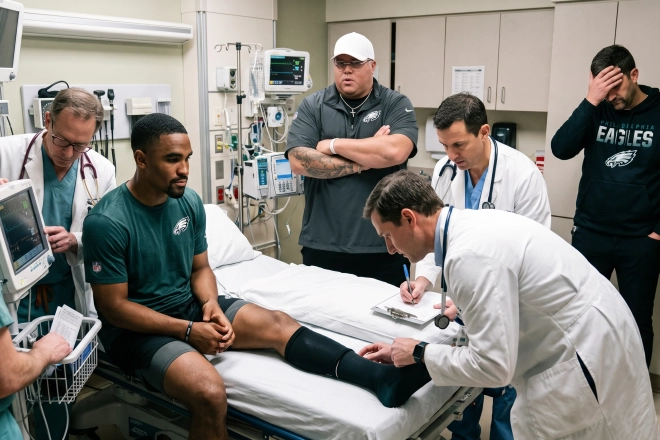
Four days after the hit, while in London, escalating tightness and local swelling prompted team clinicians to run an ultrasound. The screen located a superficial venous thrombosis (SVT)—a localized thrombus sitting in the superficial venous system near the surface, rather than deep within the central musculature.
Superficial clots do not carry the immediate, catastrophic danger of a deep vein thrombosis (DVT). If a clot remains confined to the superficial saphenous tributaries, the likelihood of a fatal pulmonary embolism is relatively low. Guided by that diagnosis, Philadelphia's medical staff made an aggressive operational call: they cleared Hurts to play.
On Sunday, October 11, at Tottenham Hotspur Stadium, Hurts played all 60 minutes in a 19–17 loss to Jacksonville.
Then came the catalyst: the flight home.
In clinical hematology, there is a concept known as Virchow’s Triad—the three converging prerequisites for dangerous thrombosis:
1: Endothelial injury (the original cleat strike against the Rams).
2: Hypercoagulability (systemic inflammation and dehydration following four quarters of NFL contact).
3: Venous stasis (blood pooling due to prolonged physical immobility).
Hurts boarded a pressurized cabin for an eight-hour flight across the Atlantic within hours of taking physical hits. In high-altitude cabin environments, lower atmospheric pressure combined with extended seated immobility slows venous return from the lower extremities. The blood pools in the calf; venous flow slows to a crawl.
Hurts received regular maintenance on Monday and Tuesday and managed to take the field for a full practice on Wednesday. But that evening, the Eagles conducted a routine follow-up ultrasound to check the borders of the lesion.
The findings halted everything: the imaging revealed "movement in the small blood clot."
In clinical practice, "movement" is not standard terminology. It does not necessarily mean a clot broke free into the bloodstream; rather, it typically indicates thrombus propagation—the clot was actively extending longitudinally along the vessel, creeping uncomfortably close to the saphenofemoral or saphenopopliteal junction where superficial veins empty into the deep system. Once a clot crosses that threshold, a superficial nuisance morphs into a full-blown deep vein thrombosis (DVT), opening the door to a life-threatening pulmonary embolism.
The Eagles instantly pulled the emergency brake.
The Precedents: How Blood Clots Alter NFL Careers
In contact sports, the danger is rarely the clot alone—it is the medication required to dissolve it. The gold-standard treatment for migrating or high-risk thrombosis is therapeutic anticoagulation (blood thinners). You cannot play contact football on blood thinners. A routine hit across the ribs or a direct blow to the helmet on systemic anticoagulants carries massive risks of uncontrolled internal bleeding, intramuscular hematomas, or fatal intracranial hemorrhage.
The NFL's history with clotting disorders offers stark case studies across the spectrum:
Christian Barmore (New England Patriots, 2024–2025): The closest active parallel. Diagnosed with blood clots during training camp in 2024, Barmore was placed on the Non-Football Illness (NFI) list and missed 13 games while on systemic blood thinners. He attempted a brief return in November, experienced a recurrence of symptoms, was shut down again, and required an entire offseason of medical management before gaining full clearance for 2025.
David Andrews (New England Patriots, 2019): After developing pulmonary emboli in August 2019, the veteran center was placed on blood thinners and missed the entire 2019 season. Because the underlying etiology was treated and cleared, he was able to safely return in 2020 and played multiple full seasons thereafter.
Tomas Vokoun and Chris Bosh (Cross-Sport Precedents): While Vokoun returned to NHL hockey after a single episode, Bosh was forced into early medical retirement in the NBA after suffering recurrent blood clots that required indefinite anticoagulation. When an athlete’s genetics or vascular system repeatedly produces unprovoked clots, the blood thinners become permanent, ending a collision-sport career on the spot.
Outlook and Actuarial Projections
As of Saturday, October 17, Philadelphia notably chose not to place Hurts on Injured Reserve. Putting a player on IR mandates a minimum four-game shelf life. By keeping him on the 53-man roster, the Eagles are clinging to the possibility that this is a localized, self-limiting superficial clot that can be managed conservatively with anti-inflammatories, compression, and monitoring rather than a 3-to-6-month therapeutic blood-thinner regimen.
The mathematical realities of his trajectory break down into four scenarios:
1. Returns in 1 to 2 Weeks (Week 7 or Week 8): 30% Probability
The Clinical Path: This outcome requires that the clot stabilize immediately without encroaching within 3 to 5 centimeters of the deep venous junction. It assumes the medical staff treats him with localized therapy, high-grade compression, and short-acting or prophylactic-level management that does not require systemic therapeutic blood thinners.
The Reality Check: If "movement" indicates the clot has already begun tracking upward toward the popliteal vein, no conservative vascular surgeon will clear him to absorb hits on a football field in seven to fourteen days. Philadelphia’s Week 10 bye sits as a logical milestone, making a return before early November an uphill climb.
2. Placed on IR / Out 4 to 8 Weeks: 55% Probability
The Clinical Path: This is the baseline outcome in professional sports medicine. If follow-up Doppler scans over the weekend show the clot continuing to expand, doctors must place Hurts on a short, targeted course of direct oral anticoagulants (DOACs) or low-molecular-weight heparin.
The Timeline: A standard initial course for an aggressive, progressing superficial clot or a minor DVT is 4 to 6 weeks. While taking anticoagulants, Hurts cannot take hits. Once the clot fully dissolves or stabilizes and the medication is cleared from his system, he can safely return for the stretch run and playoffs.
3. Season-Ending Shutdown: 13% Probability
The Clinical Path: If repeated scans reveal that the clot has officially breached the deep venous wall, establishing an active deep vein thrombosis in the tibial or popliteal veins, standard clinical hematology guidelines mandate a minimum of three full months of therapeutic anticoagulation.
The Consequence: A three-month course started in mid-October runs directly into mid-January 2027. Under those guidelines, Hurts would not be cleared for contact at any point during the remainder of the 2026 regular season, shifting Philadelphia's entire season onto the arm of Tanner McKee.
4. Career-Ending Prognosis: 2% Probability
The Clinical Path: Blood clots end contact-sports careers primarily under two circumstances: recurrent, unprovoked clotting episodes (thrombophilia or underlying genetic mutations like Factor V Leiden) that mandate lifelong anticoagulation, or severe vascular structural damage.
The Outlook: Because this episode has a clear, documented mechanical origin—direct blunt trauma from a cleat followed by the immobility of an international flight—the risk of this being a chronic condition is minimal. Unless blood panels uncover an undiagnosed hereditary clotting disorder, Hurts’ long-term career is not in jeopardy.
Immediate Tactical Blueprint & Verification Checklist
1: Serial Ultrasound Monitoring (Next 48–72 Hours): The Eagles will conduct repeat Doppler ultrasounds over the weekend to establish whether the clot's leading edge has stabilized or is continuing its proximal creep toward the popliteal vein.
2: IR Transaction Cutoff (Tuesday/Wednesday): If Hurts is not placed on injured reserve before Wednesday's (10/21) practice cycle begins, it confirms the team is treating this as a short-term superficial issue rather than an active DVT, keeping the door open for a return before or immediately following their Week 10 bye.
3: McKee's Operational Workload: Expect offensive coordinator Sean Mannion to deploy a simplified, quick-release passing structure featuring heavier 12-personnel sets to protect Tanner McKee against Carolina, insulating the offense while the franchise waits for Jalen Hurts' vascular system to reset.
===================================
Checkout our FREE Premium Articles
- RC's Daily Notes 2026: For the Week of 10/5-to-10/11 (The Week That Was...)
- 2026 Injury Research Follow Up/UPDATE Q&A with a Top Medical Advisor on: Malik Nabers
- 2025-26 Super Bowl Game Report: Seahawks 29, Patriots 13
- 2025 Offseason Analysis/Tournament Round 5: (FINAL/Super Bowl) NE v. CHI *REPRNT at SEASON'S END*
- NFL Draft 2023 Scouting Report: WR Michael Wilson, Stanford (REPRINT from 2023/FREEVIEW)
