


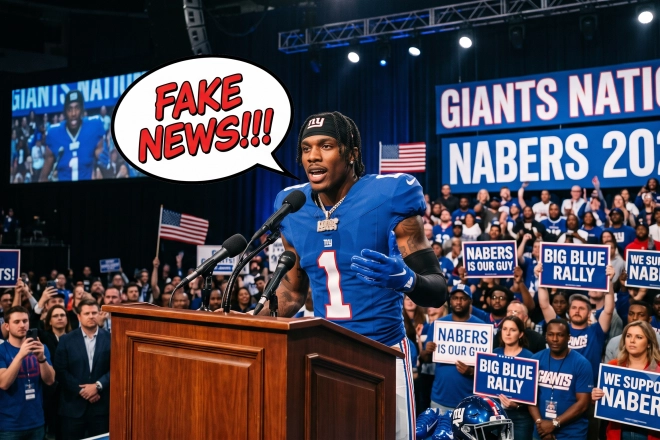
An update into Malik Nabers' injury, false dates, risks and projected timelines..
.
Another sit-down interview with me and Dr. GEMINI--prompted by the news that hit that false dates were given out about his 2nd procedure.
There's new news about the dates on Malik Nabers' follow up surgery or something? Tell me about the issue/situation and how does this affect his return to clean practicing given the tape out there of his current movement ability...and then what date will he be 'back to his normal self'?
Here is the breakdown of Malik Nabers' knee situation, his current practice status, and his projection to return to full elite form.
The Situation & Follow-Up Surgery
-- Original Injury: Nabers suffered a right torn ACL and significant meniscus tear in Week 4 of the 2025 season (late September 2025) and underwent primary reconstructive surgery in late October 2025.
-- The Follow-Up Procedure: In the spring of 2026, Nabers underwent a second arthroscopic procedure—a "clean-up" surgery—to remove scar tissue that was causing stiffness and limiting his full range of motion. Because the initial surgery involved a complex meniscus repair in addition to the ACL, scar tissue buildup (arthrofibrosis) was acting as a physical tether.
Impact on Return to Clean Practicing & Current Tape
-- Avoided PUP: Nabers surprisingly avoided the Physically Unable to Perform (PUP) list to open training camp.
-- Current Movement on Tape: Reports and footage from late July open practices show Nabers looking crisp in individual drills and running routes on air (no defenders). Straight-line tracking and light deceleration look fluid.
-- The Catch: Running routes on air is vastly different from full-contact, 11-on-11 team drills where he has to react, plant, and violently cut against aggressive defensive backs. Because of the stiffness history and secondary cleanup, the coaching staff is putting him on a strict, gated ramp-up. He is not yet doing full, clean 11-on-11 reps, and they will likely withhold him from live contact until late August.
When Will He Be 'Back to His Normal Self'?
-- On-Field Return Target: Expect him to log limited snaps as early as Week 1 to Week 3 on a pitch count.
-- Returned to 'Normal Self' Target: Late October to Early November 2026 (around Week 7–9 of the regular season).
Historically, players recovering from complex ACL-plus-meniscus repairs take roughly 12 to 14 months from the primary surgery date to fully regain their top-end lateral burst, terminal cutting power, and baseline conditioning. While he will be functional on the field prior to then, his signature WR1 game-breaking burst will likely take until mid-season to completely return.
Wait, there's a whole thing in the news today where Nabers said everyone had bad information on his follow up knee procedures, that it was done earlier--so what was the true date and how does that effect the timeline projections?
The narrative around Malik Nabers' timeline has taken a few turns between media reports and what he stated at training camp.
The True Date of the Procedure
When national reports broke in mid-May that Nabers had undergone a follow-up arthroscopic "clean-up" procedure to remove stiffness-inducing scar tissue, it was framed as a fresh, alarming setback that occurred right in the middle of the spring offseason.
However, Nabers set the record straight: the follow-up procedure took place much earlier in the spring (around late March/early April). Because the media didn't catch wind of it until May, the public narrative made it sound like a mid-May emergency surgery that pushed his timeline back toward late August or September. In reality, by the time the news broke, he was already nearly two months post-cleanup and well into his high-intensity sprinting and cutting phase.
How This Affects the Timeline & On-Field Projections
-- Shifted the Baseline Forward: Because the scar tissue was cleared out earlier than originally believed, his recovery was not delayed into late summer. This explains why he avoided the Physically Unable to Perform (PUP) list to start training camp—a milestone many insiders doubted he would hit.
-- Current Movement Efficiency: The tape of him running routes on air and working through individual drills shows sharp deceleration and fluid straight-line burst. Performing those cuts without guarding or favoring the joint confirms that the early spring procedure successfully resolved the extension stiffness without resetting his rehab clock.
-- Week 1 Impact: While Nabers emphasized that he has "no target date" and is taking a "stacking days" approach, clearing the scar tissue months ago puts him on track to be active and running real routes in Week 1 rather than starting the season sidelined or on a severe snap restriction.
Adjusted 'Normal Self' Date
-- Previous Projection: Late October to Early November (Weeks 7–9), assuming a May delay.
-- Revised Projection: Late September to Early October (Weeks 3–5).
Since the cleanup happened earlier in his timeline, his knee has already had ample time to adapt to full dynamic loading. While full, 100% top-end WR1 explosive power after a combined ACL/meniscus repair always requires a few games of live-contact adaptation, moving the surgery date up by roughly six weeks pulls his full "100% game-breaking self" projection right into the early stretch of the regular season.
So what would you say the odds are that he goes a 4-game PUP to start the season?
The odds of Malik Nabers being placed on the Reserve/PUP list (which forces a player to sit out the first 4 games of the regular season) are virtually 0% to under 5%.
1. The Procedural Rule (Why it's basically impossible)
Under NFL rules, for a player to be eligible for the regular-season Reserve/PUP list (missing Weeks 1–4), he MUST be placed on the Active/PUP list at the very start of training camp and remain on it without taking a single practice rep.
Because the Giants officially passed on putting him on Active/PUP to start camp, and Nabers took the field on Day 1 (July 29) to participate in individual drills, route running, and positional work with quarterback Jaxson Dart, he is rules-wise ineligible for the 4-game Reserve/PUP list.
2. The Roster Strategy
The primary reason GM Joe Schoen and head coach John Harbaugh kept him off Active/PUP was to avoid locked-in restrictions. Being off PUP allows him to do individual drills, 7-on-7s, and route-running with quarterbacks right now while ramping up day-by-day.
Had they put him on Active/PUP, he would have been restricted purely to side-field work with trainers.
What Happens If He Has A Re-aggravation or Delay?
If his knee reacts poorly to camp workload over the next few weeks and the Giants decide he isn't ready for Week 1, they have two options—neither of which is the 4-game PUP:
-- Inactive on the 53-man Roster (Most Likely Contingency): They keep him on the active 53-man roster, declare him inactive for Week 1 (or Weeks 1–2), and let him return as soon as he is ready (e.g., Week 2, 3, or 4) without being locked out for four full weeks.
-- Short-Term IR (Unlikely): If he suffers a genuine structural setback requiring prolonged rest, they could place him on Short-Term IR during final roster cutdowns, which also carries a 4-game minimum hold out, but it would require a new, distinct injury or major setback during camp.
Given that his early-spring scar tissue procedure is behind him, his range of motion is restored, and he is already cutting and catching passes on day one of camp, you can rule out the 4-game PUP list entirely.
What are the odds he is rushing back too quickly and he’s gonna strain or pull something else as a compensatory issue? What’s the most likely compensatory injury to occur in order of most like and share percentages and give a projected date to look for the type of injury....
The overall risk of a secondary soft-tissue strain or compensatory injury during an aggressive ACL return-to-play timeline sits at roughly 35% to 45%.
When an elite wide receiver returns from a combined ACL and meniscus repair—compounded by a secondary scar tissue cleanup—the primary surgical knee often exhibits subtle quad inhibition and altered mechanics. To protect the joint during high-velocity deceleration and violent cutting, the surrounding kinetic chain automatically offloads forces elsewhere.
Secondary Compensatory Injuries (By Risk Percentage)
- Ipsilateral Hamstring Strain (Injured Leg) — ~40% Share
-- Why it happens: The hamstring acts as the primary dynamic stabilizer of the knee, working overtime to prevent anterior tibial translation when the quadriceps hasn't fully regained peak explosive force. If a hamstring autograft was harvested during his initial surgery, the muscle belly is already structurally compromised.
-- Projected Watch Window: Mid-to-Late August (Training Camp Joint Practices & Preseason Ramp-Up). As he transitions from controlled routes on air to reactive 11-on-11 drills against physical cornerbacks, the explosive eccentric braking forces peak.
- Contralateral (Opposite) Leg Quad or Groin Strain — ~25% Share
-- Why it happens: Subconscious guarding causes an athlete to plant harder and carry more load on their non-surgical leg during hard cuts, single-leg jumps, and sudden stops. Overloading the healthy side frequently leads to acute muscle pull or adductor strain.
-- Projected Watch Window: Weeks 1 through 4 of the Regular Season (September). Once game speeds require 100% effort without rep-count limits, the non-injured side absorbs disproportionate stress across 40+ snaps per game.
- Gastrocnemius / Soleus (Calf) Strain — ~20% Share
-- Why it happens: When knee extension or terminal knee flexion is slightly guarded or stiff (the exact reason for his spring scar-tissue procedure), the ankle and calf complex take on extra ground-reaction forces during push-off and deceleration.
-- Projected Watch Window: Late August to Early September. High volume on turf surface during consecutive full-padded practices creates rapid calf fatigue.
- Patellar Tendinopathy / Quad Strain — ~15% Share
-- Why it happens: If a patellar tendon graft was used, or if the quad mechanism suffers from rapid load progression after months of relative atrophy, localized tendon inflammation frequently flares up.
-- Projected Watch Window: Weeks 3 through 6 (Late September to Mid-October) as cumulative game snaps stack up.
Bottom Line for Nabers
The medical staff keeping him off live contact in early camp directly mitigates these exact soft-tissue risks. The dangerous window opens once he transitions from controlled straight-line speed work into full-speed, reactive cutting against defensive backs in August scrimmage settings.
