


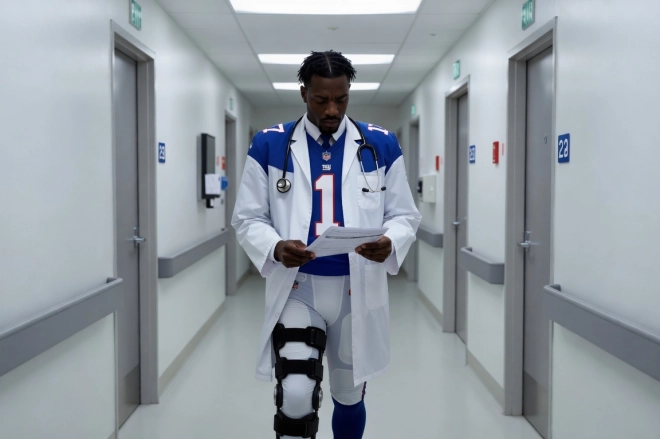
A deep dive into Malik Nabers' Injury/history/Comps and projected timelines...
Another sit-down interview with me and Dr. GEMINI. This time about Malik Nabers' issues, recovery timeline, similar comps to Nabers' injury and rehab, etc. I think you'll enjoy if you own are are thinking of owning Nabers.
Question 1: I want to discuss Malik Nabers injuries and injury history in depth. Can we begin by you laying out, in detail, in chronological order all of Malik Nabers' injuries/history -- give me detail on severity and the type of issue in some medical detail, but so that a layperson could understand and include surgeries and recovery times. I really want to dig in on his history up to the current.
Here is the full chronological breakdown of Malik Nabers' injury history from college up through his current knee recovery in May 2026. It has been a bumpy road, evolving from minor lingering issues into a catastrophic multi-ligament tear that currently threatens his 2026 availability.
College to Present: Lingering Toe Issue Nabers dealt with a turf toe-style injury during his time at LSU that has followed him into the NFL. Turf toe is a sprain of the main joint of the big toe, usually caused by forceful bending, which limits explosiveness and push-off speed. While he consistently played through it during his rookie year, he admitted to reporters in June 2025 that the possibility of eventually having surgery on it was "up in the air."
August 2024: Right Ankle Sprain During his rookie training camp, Nabers went down late in practice and had his shoe removed by trainers. The Giants avoided disaster as it was just a mild sprain. Then-Head Coach Brian Daboll described him as simply "sore" and confirmed there were no fractures. Nabers himself called it "nothing serious."
September 26, 2024: Concussion During Week 4 of his rookie season against the Cowboys, Nabers suffered a traumatic head impact. While trying to make a catch on the sideline, a defender brought him to the turf, and his head snapped hard into the ground. He missed both Week 5 and Week 6. Adam Schefter (ESPN) reported: "Giants ruled out WR Malik Nabers for Sunday night's game vs. the Bengals." He returned to the field in Week 7 after fully passing the NFL's independent five-step neurological protocol.
December 2024: Core Muscle, Foot, & Knee Ailments As the 2024 season wound down, Nabers dealt with a combination of lingering issues. He was limited in practice by consecutive foot and knee tweaks, and there were internal concerns regarding a core muscle injury (sports hernia) that he was playing through, which threatened to require an offseason procedure. He ultimately gutted out the end of the year without missing major time.
August 2025: Back Injury During his second training camp, Nabers missed 11 straight practices due to a back injury. The Giants downplayed the severity, and he managed to suit up for the start of the season, but it added to a growing list of wear-and-tear issues affecting his practice availability.
September 28, 2025: Right ACL & Meniscus Tear The most devastating injury of his career. During a Week 4 matchup against Washington, Nabers suffered a non-contact multi-ligament tear in his right knee while playing on a turf field. An MRI on September 29 confirmed he tore both his Anterior Cruciate Ligament (the primary stabilizer of the knee) and his meniscus (the cartilage pad that acts as a shock absorber).
When the meniscus is torn alongside the ACL, it significantly complicates the surgical repair and extends the initial non-weight-bearing recovery phase, preventing the knee from loading pressure early on. He underwent reconstructive surgery and missed the remainder of the 2025 season. Dr. Jesse Morse explicitly cited Nabers' injury when debating the urgent need for the NFL to ban artificial turf in favor of natural grass, noting how the surface contributes to cleats getting "stuck" and shredding ligaments.
May 2026 (Current): Knee Debridement Surgery A few weeks prior to mid-May, Nabers had to go under the knife a second time for his surgically repaired right knee. Dan Duggan (The Athletic) reported: "Giants WR Malik Nabers underwent a second surgery on his knee to remove scar tissue that was causing stiffness, according to sources."
This is an arthroscopic cleanup (debridement). Sometimes the body over-heals an ACL repair, forming excess scar tissue (arthrofibrosis) that physically blocks the knee from bending or straightening fully. The surgeon goes back in to shave that tissue out so rehab can progress.
Dr. Jeff Mueller (Physical Therapist) raised serious concerns about this setback, comparing Nabers' scar tissue complication directly to the brutal recovery path of J.K. Dobbins, emphasizing how these compounding roadblocks can severely hinder a player's return to form. Dr. Jesse Morse recently questioned whether this secondary procedure guarantees Nabers will be forced to start the 2026 season on the PUP (Physically Unable to Perform) list.
Giants Head Coach John Harbaugh (May 21, 2026) cast real doubt on his Week 1 availability: "It's such a hard thing. It's an ACL and whatever else he had in that knee. Not a simple knee, so, he's in the slog of it... Just impossible to predict. The goal is to start the season... If he's out there, great. If he's not out there, great."
Question 2: Yes, tell me about the JK Dobbins comparison and any other player in the past 3-5 years that has had a similar ACL injury and scar tissue issue.
When medical professionals and team insiders discuss a "cleanup" procedure following an ACL repair, they are generally referring to a complication known as arthrofibrosis—and more specifically, a Cyclops Lesion.
This is a dense, fibrous nodule of scar tissue that forms right at the front of the surgically repaired ACL graft. Because it sits in the intercondylar notch of the joint, it acts like a physical wedge. It prevents the athlete from achieving terminal extension—the ability to lock the leg completely straight. Without terminal extension, an athlete cannot properly activate their quadriceps, their running mechanics are entirely compromised, and they lose their explosive push-off. The secondary surgery (a debridement) goes back into the joint to shave this nodule down so the knee can actually move properly again.
Here is exactly why Dr. Jeff Mueller pointed to the J.K. Dobbins comparison, and why it is the ultimate cautionary tale for a skill player dealing with this specific setback.
The J.K. Dobbins Precedent Dobbins is the modern benchmark for how compounding lower-body issues can sideline an explosive player.
The Initial Injury (August 2021): Dobbins suffered a catastrophic multi-ligament tear (ACL, LCL, meniscus, hamstring) during the preseason.
The Scar Tissue Roadblock (October 2022): Dobbins spent over a year rehabbing and actually returned to the field briefly in September 2022. However, he clearly lacked his normal burst and was dealing with severe stiffness. After just four games, he pulled himself out of the lineup and underwent a secondary arthroscopic debridement to clear out the scar tissue that was physically blocking his range of motion.
The Fallout: While the clean-up surgery was successful—he returned late in the 2022 season looking much more explosive—the initial scar tissue complication completely derailed his development. It forced him to compensate with other muscles for months, which many medical analysts believe contributed to his subsequent soft-tissue injuries, culminating in a torn Achilles in 2023.
Other Recent Precedents (2021–2025) While these debridement procedures are not exceedingly rare, they are classified as a genuine complication that extends timelines. Another notable recent example of an NFL player having their return derailed by this exact issue is Ben Burr-Kirven, a linebacker for the Seattle Seahawks.
Burr-Kirven tore his ACL during the 2021 preseason. Nearly a year into his rehab, in June 2022, he suffered a massive setback regarding stiffness and a lack of motion. He had to undergo an almost identical secondary clean-up procedure to clear out lingering scar tissue. That complication ultimately cost him the entire 2022 season as well, knocking him off the field for two full years before he was cleared.
What This Means for Nabers Nabers' current situation mirrors the early stages of the Dobbins timeline. Because Nabers' initial injury in September 2025 wasn't a "clean" ACL tear—it included a meniscus repair—his knee had to be immobilized longer early in the rehab process. Extended immobilization drastically increases the risk of a Cyclops Lesion forming.
While the Giants' front office originally targeted training camp for his return, this secondary surgery hits the pause button on the final, most crucial phase of his rehab: explosive ramp-up.
For a wide receiver whose entire game is predicated on elite twitch and bounding athleticism, a loss of motion is highly concerning. Even though the scar tissue has now been removed, if the stiffness altered Nabers' running gait for months prior to the surgery, his muscles must re-learn how to fire symmetrically before he can safely regain his elite burst. It makes a Week 1 return highly precarious, keeping the PUP list firmly in play.
Question 3: Considering all other similar cases with the now 2nd surgery due to stiffness...what would you project Nabers exact timeline would be to get back to practicing, to fully cleared, to fully being himself/his explosive self again?
Based on the typical recovery curve for an arthroscopic debridement to remove a Cyclops Lesion—combined with the compounding setbacks from his initial meniscus repair—here is a realistic timeline for Malik Nabers' return. Because the secondary surgery took place in late April or early May of 2026, it forces a reset on his functional ramp-up.
Projected Malik Nabers Recovery Timeline
1. Return to Practicing: Mid-to-Late August 2026 While the Giants' front office is officially "hopeful" he avoids the PUP (Physically Unable to Perform) list, medical realism suggests otherwise.
The Medical Reality: An arthroscopic cleanup requires 4-6 weeks just to let the joint calm down, heal the incisions, and regain the newly unlocked range of motion. After that, he has to spend another 4-6 weeks rebuilding the quadriceps strength that was stunted while his knee was physically blocked by scar tissue.
The Projection: He will almost certainly begin late-July training camp on the PUP list. A realistic target for returning to the practice field—running routes in pads—is mid-to-late August.
2. Fully Cleared for Game Action: Early-to-Mid September 2026 Once Nabers is back on the practice field, the medical staff will need 2-4 weeks to evaluate how the knee responds to sudden deceleration and cutting.
The Medical Reality: The primary concern following a cleanup procedure isn't re-tearing the ACL, but rather joint swelling. The medical team has to ensure the knee can handle back-to-back days of high-intensity load without ballooning up and causing further stiffness.
The Projection: He will likely be cleared right at the wire for Week 1 (September 13 against the Cowboys), or potentially Week 2. However, "cleared" does not mean a full workload. Expect him to be heavily managed on a strict snap count for the first month of the season to mitigate the risk of soft-tissue compensations.
3. Fully Back to His "Explosive" Self: November 2026 – Early 2027 This is where the fantasy and real-world football impact is most deeply felt, and where the J.K. Dobbins precedent is most alarming.
The Medical Reality: Shaving out the scar tissue fixes the mechanical block, but it does not instantly fix the neurological compensations. Because Nabers walked and rehabbed with a stiff knee for months, his muscles learned to fire asymmetrically to protect the joint. It takes months of live, full-speed reps for the brain and the body to trust the knee enough to allow maximum, uninhibited force production.
The Projection: Even when he returns to the field in September, he will likely lack his trademark elite burst and twitch. History shows that athletes who suffer a scar tissue complication usually need a full 18-24 months from the initial injury to completely regain their pre-injury explosiveness. Do not expect the peak version of Malik Nabers until the back half of the 2026 season, or perhaps even 2027.
Question 4: While all this was happening did Nabers deal with his toe issue as well with surgery and rehab time on his knee?
He did not. Even though his knee rehab would have theoretically provided a long window of downtime to recover from a secondary procedure, Nabers has not had surgery on his toe.
The toe issue—which he has dealt with since his days at LSU—remains something he is choosing to manage rather than operate on. During training camp in July 2025, just a couple of months before his knee injury, Nabers admitted that surgery on the toe had been discussed behind closed doors. However, he told reporters that the idea "never really came to a complete thought in mind for me to do it." He described the toe as being like "a mosquito that don't want to go away."
When he suffered his multi-ligament knee tear in Week 4 of the 2025 season, the entire medical focus shifted to reconstructing his right ACL and meniscus. Foot and ankle specialists often prefer not to operate on a chronic toe issue if the player is already showing they can play through it effectively—which Nabers obviously did during his record-setting rookie year. Furthermore, having an immobilized, surgically repaired knee on one leg and a surgically repaired toe on the other would have made the early stages of his post-op mobility significantly more difficult.
So as it stands today, the toe remains a lingering issue that is strictly being managed with therapy, rest, and customized footwear, with no surgical intervention.
Question 5: In 0-100% odds terms, what are the chances that Nabers can’t get right for the 2026 season start and is put on a 6-week PUP? And what are the chances that once back to play his knee retears or has the JK Dobbins issues, where he's always hurt and re-hurt?
Let's put some hard probability numbers on these scenarios so you can properly weigh his risk profile for 2026 projections. Here is how the medical and historical data breaks down for a receiver dealing with this specific compounding injury path.
1. Odds of Starting on the Regular Season PUP (Missing 4-6 Weeks): 60% While the Giants' front office has stated they are "hopeful" he will be ready for the opener, the reality of the timeline heavily favors him missing the start of the season.
The Math: He had his initial ACL/meniscus surgery in late October 2025 (delayed a month to let the swelling subside). The "cleanup" surgery happened in late April/early May 2026. This reset his functional ramp-up right at the 6-month mark post-op, which is exactly when he should have been starting high-impact linear running.
The Schedule: Training camp opens in late July. If he is spending June and July just regaining basic quad strength and range of motion following the scar tissue removal, he will not be ready for contact by August.
The Insider Consensus: Adam Schefter recently noted on The Pat McAfee Show that the situation is complicated and Week 1 is in serious jeopardy. The Giants are likely to deploy the "Andrew Thomas strategy" from 2025: keep him on the PUP list through camp, activate him late, and ramp him up slowly, meaning he's highly likely to miss at least September.
2. Odds of a "J.K. Dobbins" Soft-Tissue Cascade or Re-tear: 45-50% There are two separate risks here: re-tearing the actual grafted ACL, and suffering secondary injuries because his body mechanics are out of whack.
The Re-tear Risk (~10-15%): The arthroscopic cleanup surgery itself does not significantly weaken the new ACL graft. The graft is actually quite strong. The risk of him planting his foot and cleanly snapping the ligament again remains roughly the same as any other player returning from an ACL tear.
The Compensation Cascade (~35%): This is the massive red flag. Because Nabers walked around with a physically blocked, stiff knee for months prior to the second surgery, his brain re-wired his movement patterns. His hamstrings, calves, and Achilles had to work overtime to compensate for his locked-up quadriceps. When an explosive athlete tries to run a 4.4 forty while their kinetic chain is firing asymmetrically, muscles snap.
The Verdict: The odds of him having a perfectly clean, healthy 2026 season once he returns are incredibly low. You should expect him to be a constant resident on the mid-week injury report with hamstring strains, groin pulls, or ankle soreness as his body tries to re-learn how to handle NFL-level torque.
Question 6: Did Nabers have the same type of surgery/procedure and replacement of the ACL as Dobbins...or anyone else in any sport have a similar injury and surgery and 2nd surgery for stiffness issues, and what were their timelines to get back to normal (if they did) and where the ages they were similar?
While they are dealing with the exact same post-surgical complication—a buildup of scar tissue called a Cyclops Lesion—their initial injuries and surgical details are not identical.
Nabers vs. Dobbins: The Initial Injuries J.K. Dobbins' initial injury was structurally much more catastrophic than Nabers'.
J.K. Dobbins (Age 22 at injury): During the 2021 preseason, Dobbins tore his ACL, LCL, meniscus, and hamstring. Because of the central vertical scar on his knee, orthopedic analysts suspect he received a patellar tendon autograft (using his own tendon to build the new ACL).
Malik Nabers (Age 22 at injury): Nabers suffered a torn ACL and a lateral meniscus tear. While NFL teams strictly protect exact graft types (whether they used the patellar, hamstring, or quad tendon), his joint damage was much less severe than Dobbins'.
The common denominator: Both suffered meniscus tears alongside the ACL. A meniscus repair requires the knee to be immobilized in a brace with strict non-weight-bearing limits for the first 4-6 weeks. Keeping the knee locked is exactly what allows excess scar tissue to take root in the joint, leading to the severe stiffness both players experienced.
Other Athletes with Scar Tissue Cleanups This complication, formally known as arthrofibrosis, happens in roughly 1% to 10% of ACL reconstructions. It is actually quite common in elite athletes in their early 20s, as their bodies mount hyper-aggressive healing responses that over-produce scar tissue.
Here is how other high-profile athletes at similar ages navigated this exact secondary surgery:
Saquon Barkley (NFL Running Back) Age at initial injury: 23 The Injury: Torn ACL and meniscus in September 2020. The Complication: While the Giants kept his exact medical chart quiet, Ravens Head Coach John Harbaugh explicitly told reporters in 2022 that Dobbins' scar tissue cleanup was "the same one that Saquon Barkley might have had." Timeline to Normal: Barkley returned in 2021 (11 months post-injury) but clearly lacked his trademark burst and suffered a compensating ankle sprain because his running mechanics were altered. He did not look fully explosive or "back to normal" until the 2022 season—a full 24 months after the initial tear.
Ben Burr-Kirven (NFL Linebacker) Age at initial injury: 23 The Injury: Torn ACL in August 2021. The Complication: He developed severe stiffness and nerve pain from scar tissue build-up and underwent the exact same arthroscopic cleanup procedure. Timeline to Normal: The stiffness complication completely derailed his recovery window. He missed both the 2021 and 2022 seasons, requiring a full two years of rehab before he was cleared to return to the field in 2023.
Why Nabers' Timeline Might Be Better There is one massive difference between Nabers and Dobbins that works heavily in Nabers' favor: Timing.
Dobbins tried to rehab through the stiffness. He returned to play 13 months after his injury, realized he physically could not run properly, and then had the cleanup surgery mid-season. That forced him to stop his season, recover from the second surgery, and try to ramp up all over again.
Nabers had his cleanup surgery at the 6-to-7 month mark of his rehab—before he ever stepped back onto an NFL practice field.
Because Nabers had the scar tissue removed early, he is essentially just resetting the final phase of his rehab. If he follows the standard recovery curve from here, he will likely miss September, play at roughly 80-85% of his physical peak from October through December of 2026, and completely return to his elite, explosive self in the 2027 season.
Question 7: do you mean return to play stats? And were there any other athletes in any other sports who had similar ordeal to Nabers or Dobbins?
Yes, exactly. When analysts discuss "return to play" stats for an ACL injury, they are looking at specific fantasy production and efficiency metrics—like yards per route run, target share, and explosive play rate—to measure how much of a player's pre-injury athleticism is actually back during their first active season. Wide receivers generally experience a sharp drop in their ability to separate from defensive backs in Year 1 back, while running backs typically lose their lateral jump-cut ability. For both positions, Year 2 is almost always the true return to baseline.
As for other sports, arthrofibrosis (scar tissue locking the joint) and Cyclops Lesions happen in roughly 2% to 10% of all ACL reconstructions. It spans every sport where hard, sudden cutting is required. Here are three high-profile athletes who went through an almost identical secondary cleanup surgery for stiffness, and how their timelines played out:
Ricky Rubio (NBA Point Guard) Age at initial injury: 21 (Nearly identical to Nabers' age 22) The Injury: Tore his ACL and LCL in his left knee in March 2012. The Complication: Rubio actually returned to the court 9 months later, but he visibly lacked his lateral quickness and dealt with persistent swelling. Following the season, in April 2013, he underwent a secondary arthroscopic surgery to clear out the scar tissue that was limiting his mobility. Timeline to "Normal": The cleanup worked perfectly, but the overarching timeline was long. He returned for the 2013–2014 season, played all 82 games, and looked incredibly explosive again. It took a full 18 to 20 months from the initial tear before he was entirely back to his pre-injury self.
Christen Press (USWNT & NWSL Forward) Age at initial injury: 33 The Injury: Tore her ACL in June 2022. The Complication: Press represents the extreme worst-case scenario for arthrofibrosis. Her body hyper-produced scar tissue, completely locking her knee joint and preventing her from achieving terminal extension. Instead of just one cleanup, she had to undergo three additional surgeries to shave down the stubborn cyclops lesions. Timeline to "Normal": The relentless stiffness completely derailed her rehab. She missed almost two full calendar years, finally returning to the pitch in mid-2024.
Vivianne Miedema (WSL & Netherlands Forward) Age at initial injury: 26 The Injury: Tore her ACL in December 2022. The Complication: She returned to the pitch in late 2023, roughly 10 months post-op. However, similar to J.K. Dobbins, she quickly realized her knee wasn't firing properly. She lacked her elite burst and dealt with lingering pain, forcing her to step away from the team in early 2024 to undergo a minor arthroscopic cleanup to remove the scar tissue. Timeline to "Normal": Because she tried to play through the stiffness before having the cleanup, her timeline extended significantly. It took until the fall of 2024—nearly a full 22 months after the initial injury—for her to look fluid and confident making hard cuts again.
The takeaway for Nabers: It is highly encouraging that he got this surgery out of the way before he tried to play on a stiff knee, avoiding the trap that snagged Dobbins and Miedema. However, Rubio's timeline remains the most realistic blueprint: the cleanup solves the mechanical block, but true, uninhibited explosiveness likely won't return until late 2026 or 2027.
Question 8: Yes show me for all the people we're discussing what it looked like their before ACL in a fully healthy season, then year 1 off ACL then year 2 from ACL to show prior ability then if it dipped year one off the ACL.
Here is the statistical breakdown showing exactly how the recovery curve plays out for these high-profile athletes. The data consistently tells the same story: Year 1 back from an ACL is a year of physical compromise and reduced efficiency, while Year 2 is the true return to form.
Saquon Barkley (The Best Blueprint) Barkley is the cleanest example of how a player with an elite athletic baseline struggles with explosiveness in Year 1 back, before his body fully trusts the knee again in Year 2. His 2021 season was marred by a severe lack of burst and a compensating ankle sprain.
2019 (Pre-Injury Healthy): 13 Games, 1,003 Rush Yards, 4.6 YPC, 6 Rush TDs, 438 Rec. Yds
2021 (Year 1 Post-ACL): 13 Games, 593 Rush Yards, 3.7 YPC, 2 Rush TDs, 263 Rec. Yds
2022 (Year 2 Post-ACL): 16 Games, 1,312 Rush Yards, 4.4 YPC, 10 Rush TDs, 338 Rec. Yds
Key takeaway: Notice the massive drop in efficiency. His Yards Per Carry plummeted from 4.6 down to 3.7 in his first year back, and his receiving production was nearly cut in half. By Year 2, the elite burst was back, and he returned to being a workhorse.
J.K. Dobbins (The Cautionary Tale) Dobbins tried to play through the exact same scar tissue stiffness that Nabers just had surgically removed. His Year 1 efficiency looks okay on paper, but he lacked lateral agility and had to pull himself out of the lineup mid-season for the cleanup surgery.
2020 (Pre-Injury Rookie): 15 Games, 805 Rush Yards, 6.0 YPC, 9 Rush TDs, 120 Rec Yds
2022 (Year 1 Post-ACL): 8 Games, 520 Rush Yards, 5.7 YPC, 2 Rush TDs, 42 Receiving Yards 2023 (Year 2 Post-ACL): 1 Game, 22 Rush Yards, 2.8 YPC, 1 Rush TD, 15 Receiving Yards
Key takeaway: The stiffness cost him half of his Year 1 season. Because his running mechanics were completely altered by trying to play through the scar tissue, his body compensated heavily. That kinetic chain breakdown is largely blamed for his catastrophic Achilles tear in Week 1 of his Year 2 season.
Ricky Rubio (The Multi-Sport Parallel) While basketball requires different mechanics, the demands on lateral explosiveness and deceleration are identical. Rubio played through a stiff knee in Year 1, shot poorly from the floor, and had the scar tissue shaved out in April 2013.
2011-12 (Pre-Injury Rookie): 41 Games, 10.6 Points Per Game, 8.2 Assists, 35.7% FG%
2012-13 (Year 1 Post-ACL): 57 Games, 10.7 Points Per Game, 7.3 Assists, 36.0% FG%
2013-14 (Year 2 Post-ACL): 82 Games, 9.5 Points Per Game, 8.6 Assists, 38.1% FG%
Key takeaway: After having the scar tissue removed following Year 1, he bounced back to play all 82 games in Year 2. His lateral quickness returned, his shooting mechanics stabilized, and his assist numbers climbed back up.
Malik Nabers' Baseline For context on what the Giants are missing, here is the baseline Nabers established before the multi-ligament tear derailed his trajectory:
2024 (Pre-Injury Rookie): 14 Games, 135 Targets, 86 Catches, 922 Receiving Yards, 5 TDs
The Strategic Outlook: If Nabers follows the Barkley trajectory, expect his 2026 (Year 1 back) to be highly inefficient. He will likely struggle to separate from man coverage at the top of his routes and won't have the same elite yards-after-catch (YAC) burst until the 2027 season.
RC NOTE: All the GEMINI research seems to point towards a return in 2026...possibly Week 1 ready, but might be a few weeks after/a stint on PUP. But that overall, the outlook is a iffy/not-his-full-self return in 2026 but the real 'back to himself' issue hits in 2027. *BUT that toe issue still lingers.
After going through this in more detail, I'm leaning towards: I'm not an FF-buyer in/for 2026. I use 2026 as the waiting period. But 2027 offseason or late 2026, I try to get on the Nabers train at a nice discount.
xxxxxxxx
